
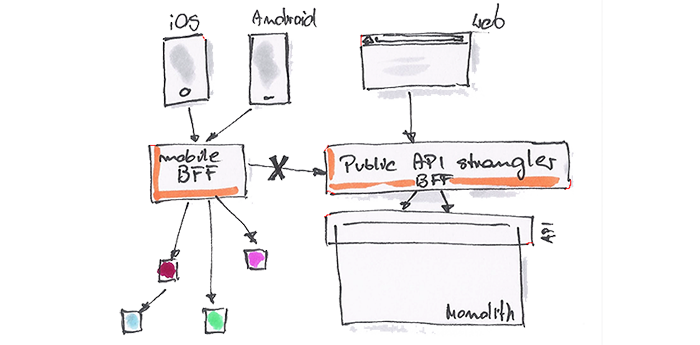
Imagine you are developing a service-oriented application that needs to support multiple interfaces, such as Web, Mobile, and Admin.
Each of these interfaces may have different requirements, features, limitations, and even workflows.
How would you design the backend to handle these differences?
Possible Approaches
1. Using a single API with `if/else` conditions to identify the client type and handle its specific requirements.
This approach gradually leads to scattered conditions, increased code complexity, and tighter coupling between different parts of the system.
2. Creating separate methods within the same Controller for each interface.
This might be acceptable for small applications, but as the number of interfaces grows, Controllers can become overloaded with multiple responsibilities.
3. Creating separate APIs for each interface within a single project.
This provides better separation at the endpoint level, but the development and deployment cycles of different interfaces may still remain tightly coupled.
4. Creating independent backend applications tailored to the requirements of each interface.
In this approach, each interface has its own dedicated backend, allowing it to evolve independently of the others.
This is the core idea behind the Backend For Frontend (BFF) Pattern.
BFF means providing a backend specifically tailored to the needs of each frontend or user experience.
However, this separation does not mean duplicating business logic. Core business rules should remain in shared services and appropriate application layers, while each BFF handles client-specific requirements.
Benefits of the BFF Pattern
- API Aggregation: Combining data from multiple APIs and services into a single response.
- Reduced Payload Size: Returning only the data required by each interface.
- Data Transformation: Adapting data to match the specific structure and requirements of each UI.
- Fewer Client Requests: Reducing the number of requests sent by clients, especially mobile applications.
- Independent Development and Deployment: Allowing each frontend's backend to evolve and be deployed independently.
- Separation of Concerns: Isolating client-specific requirements and user experience logic from other interfaces.
- Client-Specific Policies: Applying different caching, rate-limiting, and other policies for each client.
Do We Always Need the BFF Pattern?
No.
If different interfaces have similar requirements, using a shared API might be a simpler and more appropriate solution.
The goal of BFF is not to increase the number of projects or services.
Its real purpose is to reduce the complexity of serving different frontend requirements through a shared backend.